
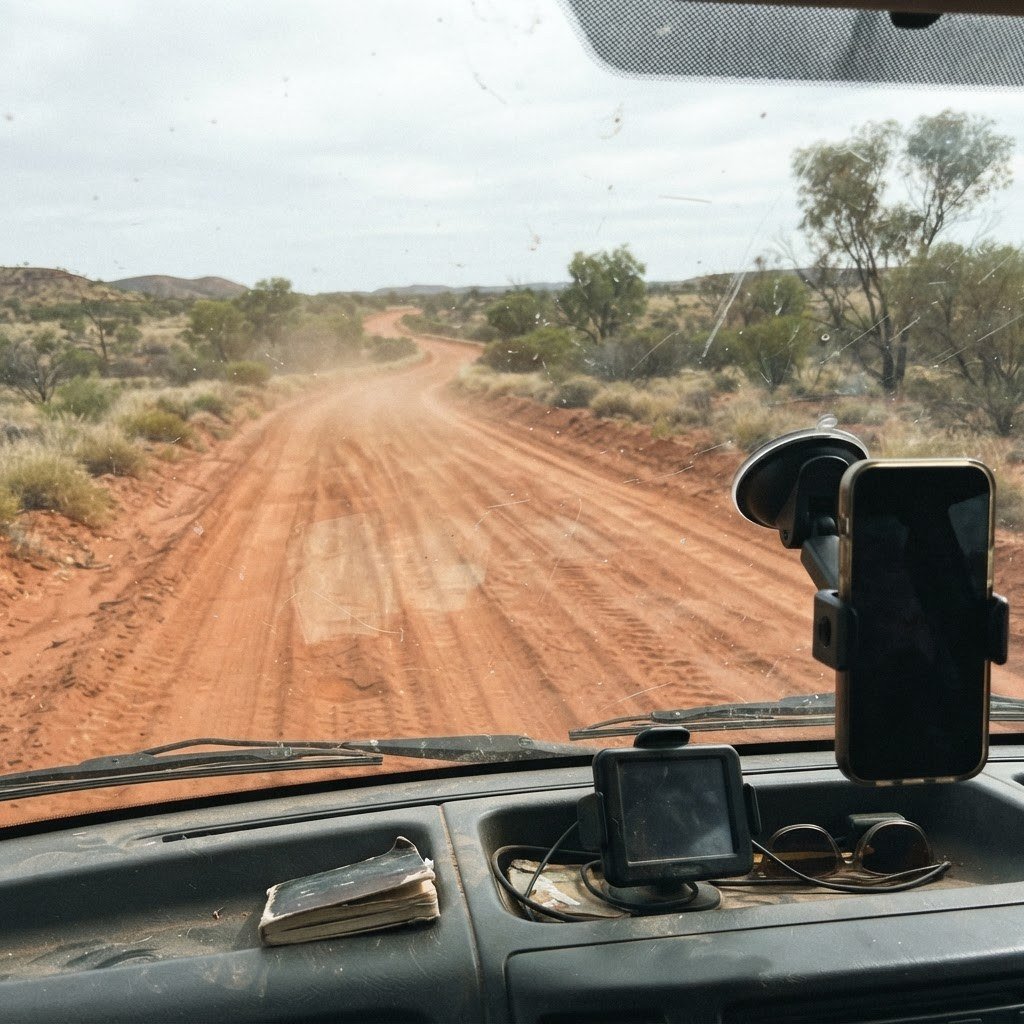

Twenty-five years of driving Australia for work taught me the hard way that anything not tied down in a car is only borrowing time. Back then it was the street directory sliding off the passenger seat at every set of lights. These days it’s the phone doing the navigating, and on corrugated roads it doesn’t slide — it launches. The fix is a caravan phone mount that’s actually built for corrugations — the trick is picking one that lasts.
If you’ve done any serious dirt-road touring, you know the sound. That rattle-clatter from somewhere near the dash that means your phone’s just become a projectile, screen-down, wedged under the seat. And there’s never a good moment to go fishing for it, usually right when the next turn’s coming up.
The good news is a phone that stays put is a solved problem — you just need a mount that’s actually built for it, and a couple of habits that keep it that way.
Why Ordinary Phone Mounts Fail on Corrugated Roads
Corrugations are vibration — constant, relentless, and exactly the kind that walks a cheap mount straight off whatever it was stuck to. The failures happen in familiar ways:
The suction cup that lets go. Cheaper mounts use hard, thin suction cups that can’t hold tension on a surface shuddering hundreds of times a minute. Add a 40-degree day softening the rubber and the phone’s on the floor within the hour.
The vent clip that’s not up to the job. Air-conditioner vents were designed to blow air, not carry a half-kilo phone bouncing on the end of a plastic lever. On anything worse than a sealed road, they fatigue and rotate.
The textured dashboard. Plenty of modern vans have a grainy dash surface that looks great and seals badly — cheap cups never grip it in the first place.
What Actually Holds: Choosing a Caravan Phone Mount
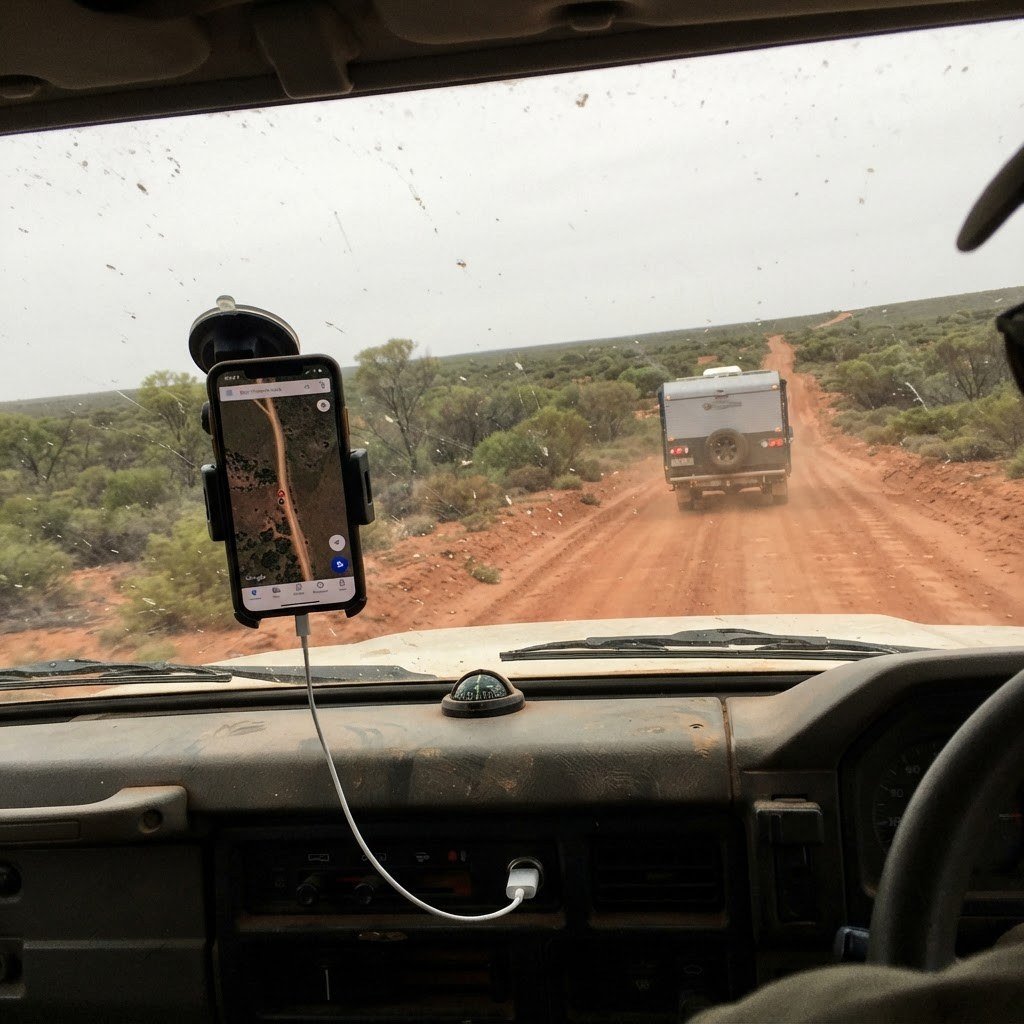
What a mount needs on corrugated roads is simple: a genuinely firm suction mount on a smooth surface, and a cradle that grips the phone itself rather than balancing it. A decent suction-mount dash holder earns its keep here — it goes on the windscreen or a smooth patch of dash, locks down properly, and holds your phone where you can glance at it without taking your eyes off the road for long. Being able to grab the phone one-handed when you pull up for a photo or a quick check of the map is part of the point too.
Where to Mount It (Without Breaking the Rules)
In Australia the rules are straightforward — in Queensland, as in every other state, your phone has to be secured in a caravan phone mount fixed to the vehicle, and it can’t obscure your view of the road. Mount it low on the windscreen or on the dash within an easy sight-line, in a proper cradle, and you’re both legal and safer, because a glance at your navigation stays a glance, not a scramble through the footwell.
Heat’s worth thinking about too. A windscreen spot baking all day in the Kimberley is hard on both the mount’s suction and the phone’s battery. If you’re parked up in the sun, unclip the phone and drop the blind.
Keep the Charge Alive While You’re At It
A mounted phone running navigation all day chews battery, and a flat phone is no better than a phone on the floor. If you’re running more than one device — phone, tablet, the kids’ whatever — it’s worth getting your 12V charging sorted, we’ve covered the basics in our guide to 12V, solar and batteries.
Quick Habits That Help Too
- Press-test the mount before you hit the dirt — if there’s any give in the suction, re-seat it before you need it.
- Corrugated roads throw dust everywhere, and dust is what kills the seal. Wipe the suction surface with a damp cloth and let it dry before sticking.
- Lock the phone in the cradle before you start driving, not while you’re moving.
- On 40-degree-plus days, take the phone off the mount when you park up and close the blind.
- Keep the charging lead long enough that plugging in doesn’t involve gymnastics.
Questions People Ask About Caravan Phone Mounts
What’s the best phone mount for corrugated roads?
A suction-mount dash holder with a proper locking cup and a cradle that grips the phone itself. Vent clips and cheap hard-plastic cups are the two that fail first — everything else is a variation on doing those two things properly.
Is it legal to mount a phone on the windscreen in Australia?
Generally yes. A commercially made mount fixed to the windscreen or dash is legal in every state, as long as it doesn’t block your view of the road. The wording varies slightly by state, but the principle is the same everywhere.
Do suction mounts fall off in hot weather?
Cheap ones do. On 40-degree-plus days the rubber softens and the seal gives up — press-test it each morning, keep the sticking surface dust-free, and take the phone off the mount when you park in the sun.
So, What I’m Saying Is…
On sealed roads, almost any mount will do. Out here, the difference between a caravan phone mount built to hold and one that came free with the phone is the difference between eyes on the road and a hunt under the seat at 80 kays an hour on dirt. Get a mount that locks down, stick it somewhere legal and in your line of sight, keep it clean, keep the phone charged — and corrugated roads stop being a phone-eater and turn into just another stretch of road.